Thursday, August 8, 2013

Running with Crohn’s: Fistulas


Running with Crohn’s: Fistula

Typical warnings apply.  This entry includes graphic descriptions of the nether end of the human digestive tract, the functions of that tract, and the surgical interventions required to treat fistulas.

A fistula is an abnormal connection between body cavities or organs of the body.  Fistulas can connect things like your intestines to your bladder, vagina, uterus, skin, or any other organ.  Because these connections are abnormal, they usually cause severe medical problems.

The fistula itself is an open wound.  Since my fistula connects to the colon, fecal matter passes through the fistula.  As you can imagine, putting crap in an open wound leads to infections.  It also means that fecal matter passes all the way through the fistula and leaks out.  I deal with this leakage using feminine pads.  While this seemed very *odd* and unmanly (?) the first time I used pads for this purpose, it seems a very natural and *practical* method of dealing with the problem now.  My wife and I actually joke about it now.  For men worried about this showing, I have had no issues with the pads showing through my shorts.  However, I am a bit worried about the new body scanners in airports.  The way I deal with these is I take the pad off and throw it away in the restroom right before the security check point, then I go through the check point, and then I pull a new pad out of my carry-on bag and put it on in the bathroom after the security check-point.

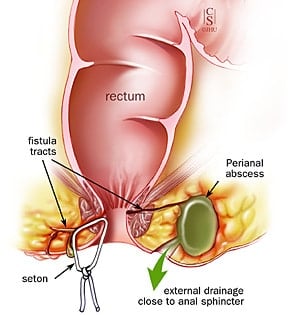
Illustration of an anorectal fistula.  Note the fistula begins as an infected pouch that gradually widens and grows in length until it reaches the outside.  My fistula actually exits the muscle and then runs between the muscle and skin for 1-2 inches before opening.

I have had three fistulas and had my third surgical intervention on my third fistula on July 31.  All three of my fistulas connect my colon with my skin.  The fistula began in the colon and slowly grew in length until it erupted within about two inches of my anus.  My previous two fistulas burrowed through skin without actually penetrating the rectal muscle walls.  Unfortunately, my latest fistula burrowed all of the way through both rectal muscle groups.

There are several different treatment options for fistula; however, they are all surgical.  However, before attempting to correct the fistula, the doctor must first ensure the fistula is as free of infection as possible.  Since this third fistula had abscessed, my first surgical intervention involved simply cutting open the fistula and draining the abscess.  My second surgical intervention included running a specially designed probe up through the fistula both to map it out and to place a rubber band like object (called a seton).  The purpose of the seton is to hold the fistula open so that as much of the infection as possible can drain out.


The possible approaches to fix fistulas include:

  • Cauterize or suture closed the interior opening of the fistula, and then permit it to heal from the inside out
  • If the fistula only runs under the skin, cut open the fistula pathway
  • Inject Fibrin glue along the entire length of the fistula
  • Insert a specially designed plug at the point the fistula penetrates the muscle wall
  • Insert a specially designed plug at the point the fistula penetrates the muscle wall and surgically modify the muscle wall to accept the plug
  • Surgically close the fistula and reconstruct the muscle wall

Fibrin glue


Fistula plug


As I understand it, the surgeon used the second approach for my fistula – it was extremely painful.  The surgeon used the first approach for my second fistula (MUCH less painful).  For my third fistula, after draining the infection, the surgeon used the Fibrin glue injection (also relatively pain free).

For my situation, the chances of the Fibrin glue injection successfully closing the fistula are remote (~20%).  The chances for a simple plug placement working are only about 40%.  Therefore, it seems likely that I will require a more invasive surgical intervention.

Le sigh

Space colony essentials: Introduction


Space colony essentials: Introduction

I am advocate of space exploration and colonization.  Eventually (likely later), humanity *has* to leave the Earth or it will face extinction.  So what exactly does a space colony require to survive?

Jamestown in space
I recently visited the Jamestown settlement and museum in Virginia.  In the museum, I read about all of the difficulties faced by the English settlers of North America.  Hundreds died and even the survivors lived miserable lives.  There is even evidence that some of the survivors resorted to cannibalism to survive during the winter seasons.

As we walked through the displays, one thought kept ringing through my head, “the people planning this expedition did not know what they were doing.”  In fact, they clearly had not thought about survival as the primary purpose of the expedition.  The people funding the expedition solely intended it to be a money making venture.  The people going on the expedition also thought of it as an adventure and had no survival training (they all were the equivalent of “city dwellers”).  No one knew what they were doing and no one had a realistic plan for the colony.

The environment around Jamestown provided shelter, food, fuel, water, air, and moderate temperatures, to the people familiar with the environment.  Space provides none of these things at least for free.  Space is an environment even harsher than that presented by Jamestown to the English settlers.

Fellow readers, welcome to Jamestown in space.

Eventually, the colonists discovered goods to trade with Europe in the environment around Jamestown (timber, tobacco, cotton, etc.).  It took the colonists years to determine which colony products were the best trade goods.  The colony needed these trade goods to pay for the technological goods the required for survival and desired for the comfort.  In the beginning of the colony, this was just about everything.


Any realistic plan to colonize space must of course include provisions for generating all of the essentials for life.  Similarly, a space colony must also provide a means eventually to repay the initial investment and an incentive to motivate people to go.  Unfortunately, we know of only a few goods unique to space that might be of use on Earth.  One goal of a space colony will be discover what space can provide.

I hope to turn this introductory entry into a series that discusses the necessities of a space colony and how that space colony might provide those necessities.  The topics I hope to cover include these:
  • Shelter
  • Consumables (Air, Water, and Food)
  • Power
  • Transportation
  • Communications
  • “Cash Crops”
  • Reasons for going

I do not promise to discuss them in the given order though :)

Running with Crohn’s: My second run


But perhaps I should call this entry “Do as I say, not as I do”

On Sunday, I wrote about my disciplined approach to resuming running and on Tuesday, I wrote about my first post-surgery run and that I stopped early to ensure that I did not complicate my recover. However, I ran again on Wednesday.  I did this partially because I felt fine and because I felt cheated out of running the distance I wanted to run.

During my run, I felt fine, so I ran the distance that I wanted to run (two miles).  However, I began hurting later in the day and continued hurting the rest of the day.  I should have taken my planned rest day.

On Thursday, I walked a mile with my wife (who is recovering from major surgery).  Afterwards, I shopped at a large box store and a variety of smaller stores.  My total walking distance was over 2.0 miles.  It has caused me to start hurting again, so I had to take part of a pain pill.  Until I can walk and not feel pain, I am going to stop running.

I guess the point of this entry is: have patience.  Recovery from injury or surgery is not linear.  You will have good days, so take advantage of them.  You will have bad days, and you must listen to your body and take it easy when you do.

Tuesday, August 6, 2013

Running with Crohn’s: Diarrhea!


Running with Crohn’s: Diarrhea!

As the title implies, this entry deals with biological functions that some will find extremely distasteful. Proceed with caution!

The symptoms of Crohn’s Disease that affect my running are small bowel obstructions, diarrhea, severe intestinal cramping, and anemia.  I also suffer from things like kidney stones & fistulas that interrupt my training.  In this entry, I will discuss how I deal with diarrhea (and to a lesser extent intestinal cramping).

Perhaps the trickiest but definitely the most embarrassing issue that Inflammatory Bowel Disease (Crohn’s and Colitis) and Irritable Bowel Syndrome (IBS) suffers must face is diarrhea.  When you are also a distance runner, this moves from the realm of embarrassment into the realm of severe logistical problem.  Over the two years I have been doing distance running, I developed multiple strategies for dealing with this problem that is so common among IBD & IBS patients.

My first strategy involves eating or more accurately NOT eating before a run.  I do not know when my diarrhea will strike but, after 25 years of dealing with Crohn’s Disease, I do know roughly ½ of my bouts of diarrhea (and cramping) happen within an hour or so of eating.  So now I never eat more than a food bar prior to running.  If this means waiting to eat dinner until 8 or 9 pm in the evening so that I can run first, that is what I do.  For some runs, I have had to go 8 – 10 hours without food to ensure that I do not trigger a bout of diarrhea and/or cramping before an important run.  When I am able to run on an empty stomach in the morning, I have found that this works really well.  When I eat energy bars or gels during a run, I only nibble the food to ensure that it does not trigger my digestive system’s massive overreaction.

CAUTION: I am not a medical professional.  Please ask your doctor about using these medications and if (s)he disagrees with my methods, then follow your doctor’s advice!

My next strategy includes using the over the counter medication Imodium.  Please discuss this option with your doctor(s) prior to using it.  My doctor limited me to eight pills per day but allowed me to take them as I deem best for dealing with my diarrhea.  On a side note, it seems to me that my system develops tolerance to this drug, meaning the more that I use it, the less effective it is.  To help with this tolerance, I will often stop taking Imodium when I can spend time at home close to a bathroom.  If I do not take these medication holidays, then I end up taking eight Imodium per day with only marginal effect.  When I do take medication holidays, I often find that only taking two Imodium per day provides a lot more control.  Prior to runs lasting more than 30 minutes, I take 1-2 Imodium.  This helps with both diarrhea and cramping. It does NOT prevent me from experiencing cramping and diarrhea during a run but it significantly reduces the chances of having these problems during my run.  I also bring Imodium with me in a Ziploc baggy (to keep it from dissolving in my sweat).  If I begin to suffer from diarrhea during the run, I immediately take another pill. If I suffer diarrhea urges again after waiting for 20 minutes, then I take another Imodium.  I have never had to take more than three pills during a run.

Check with your doctor on these drugs:

Some other drugs that may be useful include the any cramping drugs Levsin (Hyoscyamine) and Bentyl (Dicyclomine).  These prescription medications usually eliminate intestinal cramping for me but they also help to reduce the frequency of diarrhea.  Although Imodium works better, these help me.

Another prescription drug that has helped me in the past is Questran powder (cholestyrarmine).  This is normally prescribe for high cholesterol, however, one side-effect is that it helps firm up your stool.  It is especially helpful if you suffer from short-bowel syndrome and/or had your terminal ileum removed.  The powder binds bile and bile in the colon irritates the colon and causes diarrhea.  After my small bowel resection I needed to use Questran powder for a number of years before my colon began to tolerate bile.  Eventually, I weaned myself off of it.

My third strategy is to ensure that my route includes restrooms.  The trails I use to train near my home have port-a-johns and my fitness center has rest rooms.  In addition, for races longer than 5k, I look for races that include facilities at frequent intervals.  To help with ensuring I am “close” to restroom facilities, I use a “figure 8” running route.  This involves:
Leg 1:    Run ¼ of the distance away from the start point (which has the restroom facility)
Leg 2:    Run ¼ of the distance back to the start point
Leg 3:    Run ¼ distance away from the start point in the other direction
Leg4:     Run the final leg ¼ of the distance back to the start point.
The training course I use ensures I am never more than about 15 minutes from restroom facilities during any of my runs, up to and including a full marathon.  Using this strategy, I occasionally struggle with diarrhea urges during a run but I so far I have been able to overcome the urge to go until I had the opportunity to get to the available facilities.

This last bit is advice and not a strategy for dealing with diarrhea.  The company that makes PreparationH (Pfizer), a rectal cream/ointment for dealing with hemorrhoids and other rectal issues, also makes a product called “PreparationH Wipes.”  In concept, these wipes are similar to the infant wipes that parents use to clean the bums of their kids.  However, PreparationH Wipes are flushable (unlike infant wipes).  They also include both aloe and witch hazel which are both very soothing on your nether regions, especially when they are inflamed from constant diarrhea.  I highly recommend that everyone who suffers diarrhea for any reason use this product.  I personally buy & use Walmart’s generic version of these wipes (they are much less expensive but every bit as effective.  In fact, I now use them every time that I use the restroom.  When I go on runs, I always bring a small Ziploc baggy filled with these wipes.  I use them for my personal hygiene so I never have to use the coarse, sand paper like toilet paper available in port-a-johns (I also bring them when I'm going to be away from home so that I can use them when I use public restrooms).  It also means that I never have to worry about the port-a-john running out of the toilet paper!  One final blessing is that these wipes possess a high concentration of alcohol, so in a pinch you can use them as a hand sanitizer if that runs out too.

Running with Crohn’s: My first post-surgery run


Running with Crohn’s: My first run

In my last entry, I discussed the approach I used in previous recoveries and wished to use for this recovery.  Today I tried it.

My goal was 3.0 miles (walk 0.5 miles, run 2.0 miles slowly, and then cool down with a 0.5 mile walk).  However, after running almost 1 mile, I started to sting at my surgery site.  I decided discretion was the better part of valor and ended my run.  This made me realize that I never discussed another important part of returning to your training: setting limits.

I *always* set running goals and these represent what I want to accomplish.  However, I also always set limits.  I set limits to keep from harming myself during regular training.  These include heart rate limits (slow down if I get into zone 5), limits on pain (quit the run if I get abnormal pain in my joints), and other limits depending upon the run.

Because my recent surgery involved gluing my fistula shut, I set this run’s limit as any pain associated with the fistula.  After 1 mile of running, I experienced stinging in the fistula and so I quit running.

If you are recovering from injury or surgery, I highly recommend following your doctor’s advice.  Usually this means, if it hurts, quit doing it.  In the long run, you’ll recover more quickly.