Showing posts with label It's a Guy Thing. Show all posts

Thursday, March 5, 2015

Scrotal lumps

I had completely forgotten about this incident until something recently reminded me of it.

Prior to my first entry on high Prostate Specific Antigen (PSA) values, but after my last kidney stone (so probably around May of 2012) I found a scrotal lump.  I'm not certain what caused me to detect the lump but I knew once I found it that I should bring it to the attention of my Urologist.

Scrotal lumps come in a variety of different descriptions and causes.  Some causes are benign and don't require treatment while others are malignant and require immediate attention.  I highly recommend that if you detect a lump, that you seek the attention of a Urologist.

I am not a medical professional, everything else you read in this post is my non-medical professional opinion.  You should seek the advice of a medical professional if you detect a lump.

Here's a guide to scrotal masses from the Mayo Clinic

In my appointment with my Urologist, he felt the lump and determined that it was both hard and not attached to other scrotal structures (e.g. a testicle or the vas deferens).  Both indicated that my lump was more likely benign and not malignant.  My doctor ordered an ultrasound of my scrotum anyway to ensure the lump was benign.

Unfortunately, the ultrasound was kept very cold and there wasn't much scrotum to play with :)   Note to medical professionals, keep your ultrasound rooms warm if you plan to ultrasound scrotums.  It didn't help that I was slightly uncomfortable because the ultrasound technician was a cute woman.  I think I may understand in a small way the problems some ladies encounter when seeing their male OB/GYN care provider.


Despite the inability to image the lump my doctor declare the lump not-worrisome.  He suggested that if lump caused pain or bothered me that I should return and he would perform a lumpectomy and then biopsy the material.

Unfortunately for me, the manipulation of that lump did cause persistent and long-lasting dull pain in my scrotum.  This lasted for a month or more but did eventually fade away without requiring a lumpectomy.

I am now regularly checking my scrotum for scrotal lumps and do occasionally find my original one.  It has not change in any way that I can detect over the last 2-3 years.

Sunday, November 9, 2014

Exam and PSA

My Urologist tested my Prostate Specific Antigen (PSA) last week.  The result dropped to 1.92 from my last test of 2.95.  This is great news and means I won't need another biopsy in the near future.

Over most of the time since my last test I did take Saw Palmetto but I had not taken that since the beginning of September (two or more months).

I also had my prostate checked and it seemed normal.  I'll get checked again in a year or so.

Sunday, January 12, 2014

It’s a guy thing V


About 4 weeks after my last entry on my on-going PSA story and after completing my course of antibiotics (12/05/13, the Thursday after Thanksgiving), I got my PSA retested.  My PSA tested at 2.95 which is slightly lower than the 3.0 value from my previous test.

IMO, something IS going on with my prostate.  However, I haven’t experienced any gross symptoms from it (problems beginning to urinate, maintaining a stream, emptying my bladder, etc.).  I suppose this means that my prostate hasn’t swollen or if it has, then my prostate has swollen only a small amount.

My doctor seemed satisfied that the course of antibiotic stopped or slowed the prostate issue enough that he wanted to wait another 6 months and then retest my PSA levels.  This health story is interwoven with another health issue related to my Crohn’s Disease that I’ll discuss in my next entry.

Let me take a moment to recommend that you should begin getting your PSA tested before the recommended age of 40.  The idea is not to worry about the absolute value of the PSA test result, but to instead monitor the direction and speed of change.

The vast majority of the time, prostate cancer grows very slowly and is not aggressive.  Watchful waiting is a legitimate method of dealing these.  However, sometimes it can be very aggressive and if you have a family history of prostate cancer, you should begin monitoring your prostate as soon as is practical.  You should also speak with your doctor and discuss your options.

Wednesday, October 16, 2013

Running with Crohn’s: It’s a guy thing IV


I had my follow-up appointment with my urologist at the end of last week regarding my elevated and rapidly increasing PSA (prostate specific antigen).  Although he seemed open to the idea that my rapidly increasing PSA could have been caused by the fistula (and infection) and accompanying surgeries (and trauma to the prostate), he did not seem very confident that it was the cause.

His recommendations were to get retested in 1-2 months and if the PSA had not dropped, then I would get another prostate biopsy in about 3 months.  In the meantime, he felt it was worthwhile to try a round of ciprofloxacin (a strong antibiotic with activity in the prostate).  If an infection of the prostate contributed to my high PSA numbers, then this treatment should reduce my PSA numbers.  He stated that if this reduced my PSA numbers significantly, then he would not order the prostate biopsy.

Therefore, I am currently going through a 21 day round of antibiotic treatment and I am taking my antibiotic very religiously.  I also have my calendar set to explicitly not have sex prior to my next PSA blood test (also a possible factor in an elevated PSA reading).

I do NOT want another prostate biopsy if I can avoid it.

Tuesday, September 17, 2013

Running with Crohn’s: It’s a Guy Thing III


My August follow-up
I just got the results of the PSA screen mentioned above and found that my PSA had risen to 2.9.  I can’t lie, this has me very concerned, far more concerned that is probably appropriate.  The urology nurse called me and scheduled an appointment for “as soon as possible”.  Due to my and my doctor’s travel schedules, it will be on October 3rd.  Until then, I just have to deal with my mind running through “worst case scenarios.”

However, I will share what I’ve learned about my particular circumstances and how they relate to my PSA reading:

Warning: I am not a doctor, if you experience issues related to your prostate (detect a lump, problems with urination, problems with ejaculation) then speak to a urologist!

Reasons for concern:

  • The absolute value of 2.9 is high for my age.
  • The direction of change (increasing) is worrisome indicates more involvement of the prostate.
  • The rate of change has increased, indicating that involvement the issue is worsening.


There are multiple non-cancer reasons to not be too concerned about above normal PSA readings:

  • Infections and inflammation in and around the prostate (hello fistula & fistula abscess!) increase PSA readings
  • Trauma to the prostate and the area around the prostate (like surgical fistula repair) increase PSA readings
  • The last relevant issue is that sex immediately prior to the screen can increase PSA readings (and, lucky but dumb me, I had sex the day of each of my PSA draws)


Read more about non-cancerous causes for a high PSA reading.

I’ll write my fourth entry in this series after I speak to the doctor on 10/3.

Running with Crohn’s: It’s a Guy Thing II


Not an entry on running or Crohn's

Warning: this entry contains graphics that some might find objectionable.

The prostate biopsy
There are three methods of obtaining a prostate biopsy.  The transrectal and transperineal are the two most common of these (the transurethral biopsy is the third but it isn’t performed as often).

For the transrectal prostate biopsy, the doctor inserts a probe (which includes an ultrasound wand) into the rectum.  He uses the ultrasound to ensure proper sampling of the prostate with the sampling needle.  Different doctors take different numbers of samples (mine took 12 samples).  The doctor also uses the ultrasound to measure the prostate and ensure it had a normal consistency.

Because I have extensive rectal scarring (from fistulas and other Crohn’s related problems), my anus is smaller than typical (and smaller than it used to be).  Therefore, the probe caused me substantial pain, rectal tearing, and bleeding.  In addition, the sampling with the sampling wand was very unpleasant.  Since my father had warned me that the procedure was unpleasant, I had taken the maximum dose of pain medication left over from my kidney stone procedure (2x 5mg/500mg Vicodin).  Although this did not deaden the pain, it made the procedure much less traumatic.  Note to any doctors that might read this blog, please prescribe your prostate biopsy patients two prescription strength painkillers for this procedure – I think those made the process much more tolerable!

The doctor took the biopsy samples by driving a needle through the wall of the rectum and into the prostate.  Each sample hurt pretty badly for me (some people report that taking samples on them is relatively pain-free).


Transrectal biopsy


After the biopsy, expect blood in your urine, ejaculate, and stool.  I continued getting blood in the ejaculate up to a month after the biopsy.  I stopped getting blood in my urine and stool after just a few days.  I found ejaculation somewhat painful for a number of days to perhaps a week.


Both the ultrasound and biospies showed no irregularities in my prostate, so the doctor recommended a follow-up PSA screen in 6-months (August of 2013).

Running with Crohn’s: It’s a Guy Thing I


This entry doesn’t discuss running at all.  Instead, I’m going to talk about the prostate.  If you don’t care to know about the details of male plumbing, then you should stop reading here.

Warning: this entry contains graphics that some might find objectionable.

The prostate:
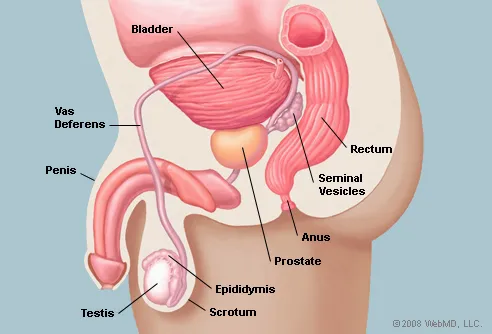
The prostate gland is a doughnut shaped organ that surrounds the urethra (as illustrated in the graphic below).


Like women’s breasts and ovaries, men’s prostate glands are more prone to developing cancers than many other organs.  Urologists use a blood test for “Prostate Specific Antigen” (hereafter-called “PSA”) to determine whether men possess a higher or lower risk of developing prostate cancer.  In general, doctors consider high PSA numbers bad.  However, for many men, they look more closely at how the PSA numbers change over time rather than the absolute number (increasing numbers are bad).

PSA levels in men tend to increase as men age.  Therefore, younger men often possess low or undetectable quantities of PSA.  Doctors used to use 4 ng/mL to differentiate between men with low chance of having prostate cancer and men with a high chance of having it.  More recent studies indicate that the direction of change and the “velocity of change” in this number are stronger indicators of cancer risk than the absolute number.


And me
In early 2012, I developed a kidney stone.  In March my urologist surgically removed that kidney stone (a topic for another entry J ).  I went back to the urologist in August for a follow-up appointment.  In that appointment, I mentioned to my doctor that my family had a history of prostate cancer (in my maternal grandfather).  Because of that indicator, my doctor advised me to get a PSA test, which I did.  My PSA test indicated a 2.15 PSA.  Not a high reading for someone in their sixties, however, my urologist felt that it was high for a fit 47 year-old.  He advised me to get my PSA taken with a differential.  I did this and got a similar PSA reading.  Therefore, my urologist recommended a prostate biopsy.


I declined because I had begun to exhibit some signs that I had a fistula and I had read that infections in and around the prostate could trigger higher PSA readings.

The doctor agreed that the fistula might cause the elevated reading, so he suggested that I take a 30 day round of antibiotics and then get my PSA retested.  Therefore, I did this and then got my PSA retested.  My third reading (after the antibiotics) was 2.05 (still high for a man in his mid-forties).  At this point, I agreed to get the prostate biopsy (this happened in January of 2013).

I'll discuss the prostate biopsy in my next entry.